I’ve been wanting to start blogging regularly for some time now, and maybe the pace of summer has given me time to reflect and want to write these snippets. I’ve been looking for middle leader blogs recently and it struck me that there aren’t many practical ones. So I thought, why not throw some thoughts into the ether.
I want to start by talking about the importance of gratitude as a leader, because it’s something I’ve been thinking about a lot recently. My current school has a systemised way of praising colleagues in an anonymous shout out system, and I was explaining to people in the last week of term that I prefer praise where I can put my name out there – if I’m grateful for something, I want people to know that I’ve said thank-you. And someone else argued that they would much prefer it to be anonymous – they find it awkward giving praise in a public way. This system is for all members of the school but it got me thinking about how important it is, in leadership, to ensure you show gratitude to the team you have.
Gratitude as a middle leader isn’t just about being polite (although, frankly, my mum raised me to be grateful and so maybe this is a part of why I think it is really important) but it’s also about building a culture within a department – motivating your team, building trust, and highlighting your own sense of pride over the contributions members of your team make. It also helps to encourage collaboration, models kindness towards other members of the team, and helps to retain staff as they feel like they are valued. A lack of gratitude from a leader, for me, is dangerous – it indicates they haven’t noticed your contributions, and can leave people feeling like they want to find somewhere else where their efforts don’t go unnoticed.
On the opposite side though, showering people with praise comes across as false – just like in a classroom where students can see through fake praise, so can adults. To me it’s important that the praise is specific and linked to tangible actions the teacher has completed in order to contribute to the team. I often try and focus on praising things where people have gone outside their comfort zone, stayed late for a school event, contributed to an initiative, shown skills of an expert level – I certainly am not praising someone for doing the basics as the praise then does not seem valid. I try to be consistent with the praise – regular enough to show I am noticing what my team do, but not so often it feels forced. Most importantly, praise has to feel authentic; I really do not want my team to feel like praising them is part of my checklist of things to do as a HOD.
So, coming up with these ideas has taken time because these are organic things I do and I’ve added them to this blog over time, rather than sat down to write this. I threw it out there a while ago and I have continued to tweak it since, but I’m thinking it’s time to put it all out there, because people said they wanted to see it, and frankly, I wish blogs like this were available when I first became a middle leader. I’ve also called this ‘Middle Leadership Chronicles’ as I am going to endeavour to post one every month at least (famous last words) to support those in middle leadership roles. I already have a couple ready on 10 ways to model excellence as a middle leader, 10 ways to encourage collaboration in a team, and 10 ways to get learning walks right. I also wrote one some time ago about developing subject knowledge, specific to department leads, which you can read here if you want to!
For me, working under a leader who does not verbalise their gratitude can be really difficult. I did not realise this before writing this blog but there is a piece of work from Chapman and White on The Five Languages of Appreciation in the Workplace. They are acts of service, quality time, words of affirmation, gifts, and appropriate physical touch (to clarify – think handshakes, fist bumps, high 5s). If I really think about it, the leaders I have felt truly valued by have offered me a range of these, but most prominently, quality time and words of affirmation. Probably because this what makes me feel valued. Gifts or acts of service in the workplace mean little to me personally.
Have a think – if you are a middle leader, what are members of your team looking for? I think it’s worth realising as a leader that people feel valued in a range of ways (and don’t think they will only need what you need to feel valued), and so, you have to be flexible and try to show gratitude in a lot of ways to all of your team to ensure that at some point you hit the nail on the head and they genuinely feel it. If you’re lucky, they may verbalise when they feel recognised, and then you will know how different members of your team feel seen, and can ensure you offer that strategy to that person. This isn’t about being strategic, it’s about catering to the needs of your team and ensuring people are fully seen and heard.
So let’s get into it – 10 ways you can show gratitude as a middle leader – and I’ll mention the categories I think it falls into. I’ll be avoiding physical touch though – you know, for the context of UK secondary schools, and, well, HR reasons…
1. Say it, or write it, and mean it
Verbal praise✓
The most prominent way I have seen gratitude shown across schools is with cards or written thanks. I think it’s worth noting that some people do prefer a verbal thanks, maybe it comes across as more genuine, but I do personally enjoy sitting down to write cards of gratitude at the end of the school year (note, I also write these to my line manager, reprographics, and anyone else I line manage or I feel has contributed to making my job easier. For example, at my previous school my department building had a set cleaner so they got a card/gifts too.)
I also try to do small cards or postcards at significant moments – always to Y11 teachers post-exam season because my team always clock up those extra hours with the kids, if staff attend events like prom, the school show, etc and represent the department I will always make a point of thanking them afterwards, whether verbally or with a note. Sometimes, this is in conjunction with a little sweet treat…
2. Bake it, make it or buy it
Gifts✓ Quality Time✓ Acts of service✓
An old classic, of course, is ensuring your department/ team are well-fed and watered. For me, I have failed miserably if I hold a meeting without bringing some sort of snack. I’m pretty sure this comes from my first school, where both my heads of department were relentless in ensuring snacks were provided for meetings. So it’s engrained in me – and has spilled into pretty much my working life. A late night of parents evening? I offer the department a Starbucks/Costa the next morning. A particularly gruelling marking period? I bring extra biscuits/ crisps/ nuts/ cake into school so that I know if people are staying late to mark they have some fuel. This has kind of seeped across the department I currently lead and people now regularly bring in snacks to keep it available for everyone. It boosts morale, yes, shows gratitude, yes, but also gives people a reason to sit together at break rather than working through it, and this is always good for building team connections and morale.
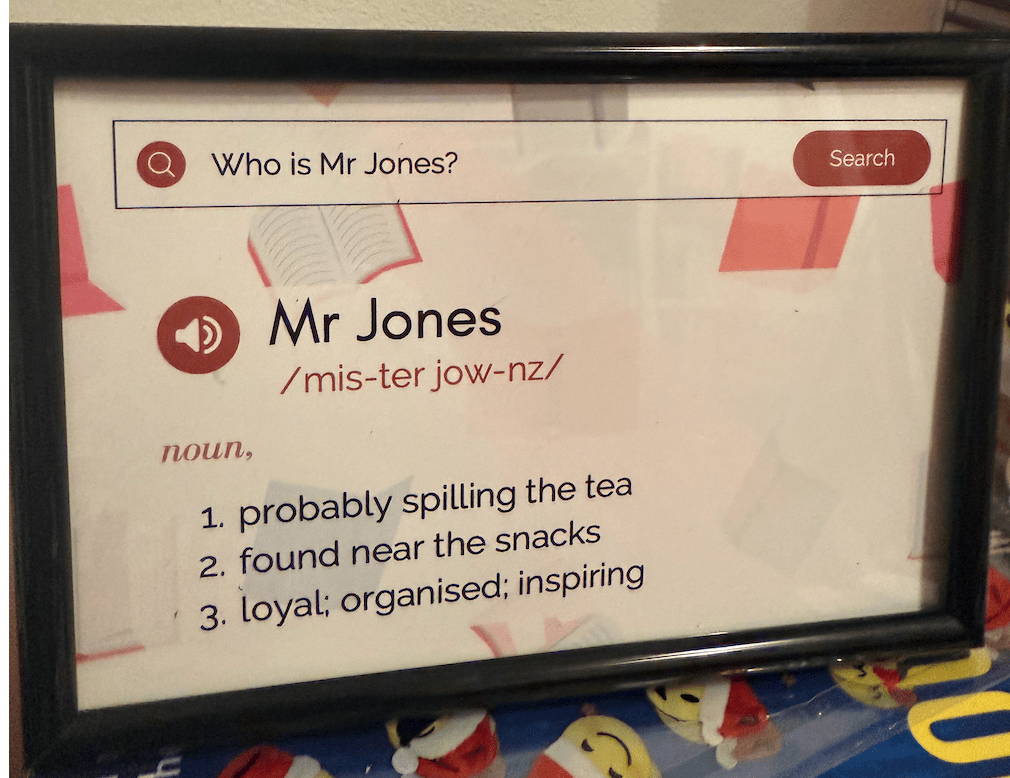
Aside from those general snack providing I will also buy edible gifts alongside a card if I feel people have gone above and beyond. I create end of Christmas/ year packs for my team and within them I try and include things I know the team like. It’s not always super expensive gifts – I also try and be thoughtful – like creating frames and nice print outs. When I left my last school I was going to buy online gifts but then created the following for each member of the team – with a focus on what they each liked or had spoken about in the 6 years I had worked there first as 2ic then as HOD. In my current school I made little frames defining each person as we were mostly a new team with relatively empty working spaces, and I wanted everyone to have something that characterised them. These things take time, and rely on points 4 and 5, but they make people feel seen more than a large bar of chocolate or a bottle of wine.


3. Make group celebrations special
Quality Time✓ Acts of service✓
It takes a bit of organisation, but, I love having a birthday fairy system in a workplace. I love that on or around birthdays the team gathers to open presents from someone and it creates a sense of togetherness, as well as learning what people like. Ideally it rotates around so that people get to know different people each year. All of these things help to build a sense of belonging because you feel seen in the workplace.
As people move on to new jobs, it’s important to celebrate them and their contribution to the team. It’s worth organising a get together (if you know the person you will know what they prefer – a night out, a day at the cricket, a meal out, a potluck style thing at work – all things I have organised!) as well as gifts, where people contribute, not for financial reasons, but so it feels like a collective celebration rather than a leadership appraisal/thank-you/exit system! I also always love celebrating special events – going to have a baby? Expect a gift bundle. New job? Expect some stationery Wedding time? You know the department is giving you a great present. Mentioned a book/genre that you would enjoy? Will probably be in your end of year gift basket. This year a member of my team passed her driving test, so I made a little car starter kit hamper and got a card for everyone to sign. People have milestones and they move on for various reasons. For me, there is no bad blood, but I want to send them off with my team with kindness and best wishes.
Oh and one that we do a lot at my current school – shared buffet systems before parents evenings, or shared breakfasts on certain days. Everyone brings something (we normally have lots left!) and we just sit and eat and chat together. In such a busy work environment I love creating chances like this to team build and connect in a natural way.
4. Actively listen … and carefully
Quality Time✓
This links in with point 5 well, but for now let’s state – it’s really important to give your team the whole of you. I have worked with staff members who were grateful for gifts, words, service, but in reality, what they wanted was time – to vent, to talk something through, for guidance, for support, for ideas, for solutions. It’s important in these moments to show you value staff by giving them that time and listening carefully to what they need. This means no multitasking, no glancing at e-mails. If you need to do that, in the moment – tell the member of staff. I will say “Just give me a second to finish this so I can pay full attention” or if urgent I just drop what I’m doing – because there is nothing worse than feeling your leader isn’t listening properly. This includes putting away phones/devices in important moments, and really hearing them out.
Listening carefully is an important skill – avoid assumptions, check with them what they are looking for (this is a classic – don’t always assume people are coming to you to fight their battles or to give them solutions, sometimes they just need an ear – professional or personal). If you listen well you can get to know people better, see what is bothering them, ensure unity and harmony across the team, and deal with any issues before they arise.
5. Know your staff at a human level
Quality Time✓ Acts of service✓
On the bottle of wine I mentioned in part 2 – I detest wine – don’t drink it, won’t touch it, and have spent years being handed it as a gift by various leaders. I’m not ungrateful, I’d never say anything. My husband is very happy at the end of term if I return with a bottle (or 6) of wine. However one of my line managers once spent the time to actually ask me what I like to drink, and when I jokingly told him I tend to have a red bull each day to keep me going and drink far more red bull than wine – he bought me a pack of red bull at the end of the year. When I received it, I had completely forgotten that conversation. Now – it may appear strange to some – but to me this was the first time a gift resonated, and I felt valued, not because of the money (red bull is cheaper than the wine he used to give me, no doubt) , but because he took the time to get to know me.
I know I have saved this until number 5 but for me this is number one in terms of showing gratitude to the people you lead. Spend time getting to know them, and file away pieces of knowledge for later gift giving or even just for conversations. One of the best leaders I ever worked under would ask me each week how Darren and Jude are (my husband and son) would ask how my son is finding year 1… or whatever year he had moved to, would ask how my husband’s football team was doing. If I look back I realise there is an intentional choice here to lead in a human way.
When I think about it, I could tell you the names of the children or partners of everyone in each department I have worked in, I can reel off their holidays, significant family events – because I listen and I get to know people. Not because I want them to feel valued to be honest – because I am a human being – but I think it’s worth mentioning because I think it’s one way we often underestimate and don’t realise how much weight it holds in terms of showing your team how valued and recognised they are. I have worked under leaders who could tell you very little about my life and that’s okay for me, frankly – but there are certainly some people who would not like this aspect of them being understood. It may be someone in your team. Sometimes in schools it can feel like you are being treated as simply a robot to be delegated to – this is a dangerous path to go down if you want complete buy-in from your team.
6. Use meetings for public shout outs
Verbal praise✓
I think department meetings are the perfect time to praise people – any contribution to the department by someone else, any idea, thought, contribution that supports the development of the team – all of these need to be celebrated. Sometimes if we are discussing a change and it comes from something I have seen/discussed, I will make this clear “Thanks to x who mentioned that this isn’t quite working” “I had a great chat with y which made me think of this differently, so thanks for that” – it creates an open space where people feel they can contribute and are not taken for granted in terms of what angle they bring to the team.
Similarly, I always shout out and praise members of the team who mark exam papers – if they marked a recent series they are more of an expert than any of us. I’ll go to them in meetings and celebrate their decision to do this additional CPD (to me exam marking is the best CPD available and should be heavily incentivised by sensible schools who want to improve outcomes). Also, I want others to see how that individual has gained knowledge from that PD so they can see the value it holds within a department.
I also think when having group discussions it’s really important to give everyone space to talk. Sometimes I know meetings can feel like you are being treated as children, and this is a fine balance, but I try to use paired talk lots in meetings and then ensure I go to every group to contribute. I have definitely been in departments (including my own, in the early days) where certain voices have been amplified and others have been silenced, and this is simply not okay. Give everyone the floor, prevent an echo chamber, and respond precisely to contributions, showing gratitude in the way you take notes, and how you respond to what people say both in the moment and returning to it in the long term. Matthew Syed’s book, Rebel Ideas, really transformed how I held meetings and responded to ideas within a team. It’s a great read.
7. Pair praise with opportunity
Quality Time✓ Verbal praise✓
If someone does something to contribute to the department off their own back, it’s worth considering how you can expand or develop their skill set going forward based on things they have learnt or have got better at during that period. After giving the verbal praise – ask them why they contributed in that way. Is it something they want to work on in the future? What about that aspect interests them? Then offer an opportunity to expand that skill – no pressure, no expectations. 9/10 people will take up the opportunity. What’s important is that you support them through the development, because no one wants to feel used – imagine being that member of the group during group work who always does all of the work (I hate group work) – this is not what we are aiming for.
Sometimes, in reality, people feel valued and recognised when they are given opportunities to learn and grow. What direction do each of the members of your team see themselves going down in the future? What roles in school interest them? All these questions should be asked – and we, as middle leaders, should put in place opportunities for staff to work on aspects of these avenues so that when the opportunity arises, they are ready. I am a big plan of stepping ahead. A leader used to ask me “If you were hit by a bus tomorrow, who would be ready to replace you” – I mean pretty morbid but I needed to hear that at a stage where I resisted delegation in fear of overworking people, because I soon realised I wasn’t supporting people with their next steps. I look for in school opportunities for members of my team, when they are ready, so that they can continue to feel fulfilled in the work place. If that means leaving the school, then I hope they have spent time in my team becoming a better teacher and a better leader. Give them opportunities, and show how you value them in the long term, not just in that moment.
8. Understand time pressures and act on them
Acts of service✓ Quality Time✓
Sometimes people hit real pinch points in the year. Sure, mock marking period, exam period, these happen to all of us. But if you know your team, you will know when particular things are coming up – maybe an important family event, maybe an anniversary or child’s birthday, maybe an unexpected illness, perhaps a regular hospital check up. These are the times to be proactive with that person and offer support or stepping in – cover a duty, sort a bit of photocopying, deliver a drink, cover them for a toilet break – do those acts of service that show they are valued, because when things are challenging, that’s when people clock who is being supportive. I was a teacher with a TLR when I was pregnant, but I quickly saw who cared – I worked in a classroom near an excellent HOD of another department who regularly checked in, ensured I was hydrated, stopped me carrying stuff around at 36 weeks, you know those people. I learnt a great deal from her about how to lead.
Never wait for someone to tell you they are behind on a deadline – or worse, that they’ve missed it. See who is struggling, read their workload and their demeanour, be a human, and speak to them. The deadline might not be able to be change but the level of support you offer can – I have helped mark papers, put exams in alphabetical order for someone else just to speed up the process, taken the papers and entered the data – just anything to alleviate pressures. In fact, never wait for someone to tell you they are struggling – check in, ask them if everything is okay – because there is nothing better than realising that you are noticed and that someone is there to help – not to nag or moan, but to help.
There are always signs that people aren’t working at their best – just keep an eye on the signs and offer support when you can. This shows you are grateful for their 100% but also grateful for them being in and present for the kids even if they are not at 100%. Oh and sometimes, people do just need to go home. I know those who run cover across the land will hate me for saying this – sorry – but sometimes people just aren’t in the right headspace for being in school, and it’s okay to tell them this. This shows true appreciation and gratitude – putting the human before the teacher.
9. Always back and promote your team
Acts of service✓ Verbal praise✓
So much of leadership is about trust and I think it takes trust to hold people to account and for them to take feedback on, but you build that trust by not sharing those issues in public forums or with other departments. In public, my team are golden to me (they’re amazing, of course they are) so I champion them, I push forward what they’ve done well, I celebrate their results, I offer them to support with students they have a great relationship with – I am their biggest fan.
This builds a sense of security in your leadership. Imagine being at a meeting and hearing that your leader has said you wouldn’t be good for something, or called you out for something in public? Every ounce of culture, value, recognition is demolished. Sure, in private, one-on-one, I will speak to members of staff about things they might need to work on. I am honest – love a bit of Radical Candor (historically by the way, hated doing this) and I think this also shows value to be honest – I think my team members would be disappointed if they did something terrible and I didn’t speak to them about it. But in public meetings, with other leaders, I am their champion. It helps that they are genuinely great, of course. I want to have a thriving, supportive, collaborative team, so I model the behaviours I want to see in them, and one of those is loyalty to each other and having each others backs.
10. Model gratitude and just be grateful. Always.
I have this thing that when a child does something for me – carries a box of books, goes and finds something, picks up litter when I’m carrying something – I have to give them chocolate. It’s a curse, probably. An expensive one. I think students do enjoy tangible tokens, but we also have a great praise system in my school that you can utilise to really celebrate students. I like to do this to say thanks to students – to promote a culture of gratitude in the department. Gratitude, being kind, making sure people are seen – this is not a leadership tactic. I haven’t sat in my dark lair stroking a cat coming up with ways to make people do what I tell them. This is a cultural value, and doing the same with students builds a positive climate in the department and encourages team members to follow suit. I am known within my team to deal with a student, of course, to offer behaviour support. But you can also bet that when I do learning walks I’m giving praise to a student, mentioning their hard work in English when I next see them, and ensuing my staff see that not only are their contributions valued, those of the students are too.
That’s all from me – I hope something here was useful for you!

 Laura Webb CPD
Leave a comment