
The final countdown: exam season principles (April subscribers content)
The April blog discusses 10 strategies for engaging students in writing about semantic fields, emphasizing a structured curriculum approach that enhances analysis skills, creativity, and connections within their writing.


Connecting conversations: moments of discussion which unlock ‘Macbeth’ (subscribers only)
In this February blog there are 10 high-leverage words for teaching Macbeth and ideas to connect them across the play. Resources are included

Fuelling analysis: tethering vocabulary to methods
Welcome to the February blog for website subscribers. This month we will discuss 10 ways to improve student analysis of key methods, using vocabulary banks.

Making micro changes 2: accelerating precision within the purpose
Welcome to the January blog for website subscribers. This month we will discuss 10 resources to support students in being precise and specific when writing closing sentences for their analytical paragraphs.

Making micro changes: accelerating precision within points
Welcome to the December blog for website subscribers. This month we will discuss 10 resources to support students in being precise and specific when writing opening sentences for their analytical paragraphs.

The new structure question: responding to the new effect focus
This November blog discusses AQA’s new structure questions, illustrating how students can comment on various emotional effects in texts. It emphasizes the necessity of recognizing structural choices that evoke tension, anxiety, sadness, and curiosity. Examples from different extracts highlight the importance of guiding students in analyzing these emotional transitions.

10 things I gained from a visit to Ark Soane Academy in London
The April blog discusses 10 strategies for engaging students in writing about semantic fields, emphasizing a structured curriculum approach that enhances analysis skills, creativity, and connections within their writing.
Concept vocabulary: 10 action verbs to comment on the writer (subscribers only)
The October blog emphasizes teaching students vocabulary that helps them analyze writers’ intentions beyond the text. It explores various purposes, such as persuasion, critique, and moral judgment, encouraging students to frame analysis with precise language. This approach fosters deeper understanding and improves performance in exam responses.

Exploring the reports on the exams: 10 thoughts on shifts and changes (subscribers only content)
The April blog discusses 10 strategies for engaging students in writing about semantic fields, emphasizing a structured curriculum approach that enhances analysis skills, creativity, and connections within their writing.

Middle Leadership Chronicles: The importance of gratitude
I’ve been wanting to start blogging regularly for some time now, and maybe the pace of summer has given me time to reflect and want to write these snippets. I’ve been looking for middle leader blogs recently and it struck me that there aren’t many practical ones. So I thought, why not throw some thoughts…

Building colour imagery: 10 activities to encourage precision of description (subscribers only content)
This blog discusses 10 activities aimed at enhancing students’ skills in writing detailed color descriptions. It emphasizes the importance of precision, vocabulary development, and mood creation through color imagery, ultimately building students’ confidence and understanding in creative writing.

Exploring morality: a 10 step process to embedding concepts in the English classroom
The April blog discusses 10 strategies for engaging students in writing about semantic fields, emphasizing a structured curriculum approach that enhances analysis skills, creativity, and connections within their writing.

AIC Deep Dive: Stage Directions (subscribers only)
The June blog for subscribers covers key stage directions in An Inspector Calls, highlighting character analysis, usage of interruptions, and the cyclical structure of the play to deepen student understanding and discussions.
Picking out patterns 2: a staggered approach to teaching micro quotations (subscribers only)
Welcome to the May blog for website subscribers. This month we will discuss 10 revision activities to supports students in using short, embedded quotations to justify their ideas in responses.

Picking out patterns: a staggered approach to semantic fields (subscribers only)
The April blog discusses 10 strategies for engaging students in writing about semantic fields, emphasizing a structured curriculum approach that enhances analysis skills, creativity, and connections within their writing.

Exam hacks: 10 tips and tricks for the language papers (subscribers only)
Welcome to the March blog for website subscribers. This month we will discuss 10 speedy strategies to leverage marks in the language papers – just in time for Y11 fever to begin!
Tackling unseen poetry: 10 steps towards ideal responses
Welcome to the February blog for website subscribers. This month we will have a quick whizz through the process I teach students when encountering the unseen poetry exam paper.
Interesting links: 10 unusual connections between the P&C cluster (subscribers only content)
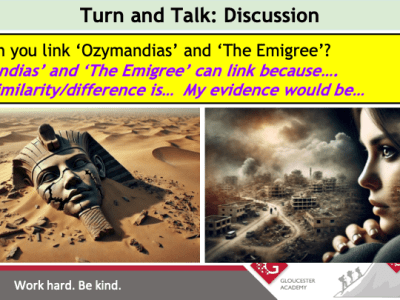
I’ve had some requests for more on the AQA power and conflict cluster, as the sessions I have previously done were focused on conceptual clusters and how to connect poems this way, rather than the specifics of how I teach the poems, and some of the finer details around the poems. So the CPD video…

High leverage: 10 strategies for comparing content, P2Q2 (subscribers only content)
In this month’s exclusive content we are looking at high leverage strategies for the English Language papers – this is the second part of a two month series and this month we are focused on language paper 2. The blog explores different ideas and resources to improve student responses in P2Q2. Enjoy!

High leverage: 10 strategies for language analysis (subscribers only content)
In this month’s exclusive content we are looking at high leverage strategies for the English Language papers – this is part of a two month series and this month we are focused on language paper 1. The blog explores different ideas and resources to improve student responses in P1Q2, with some crossover to P2Q3. Enjoy!
Something went wrong. Please refresh the page and/or try again.

 Laura Webb CPD