Today we continue through the more emotional elements of middle leadership by looking at what to do when it feels overwhelming. Being a middle leader is quite tough: you feel pulled from above and below, and this can lead, at times, to the feeling that there is so much to do and so little time. For a while when I became a Head of Department I did try and do it all, but I soon realised that it was not possible. I have always loved the fact that as a teacher your job is never done – we are always improving, developing, moving things forward. But with middle leadership this becomes even more intensified, and it can feel overwhelming.
For today’s blog we are looking specifically at time management and prioritising, which does not fit into a specific section in the book; instead we are looking at the soft skills around middle leadership. What’s more, this is not actually specific to Heads of Department – Heads of Year should hopefully gain some insight too, as well as any other middle leaders within school environments. I want to give 10 clear actions people can use when they feel overwhelmed or at capacity, and hopefully even if you know that all ten won’t work for you, you may find some mechanisms to support you in your middle leadership journey in the new school year.
Still to come in the blog series – ’10 uncomfortable truths about middle leadership‘ and ’10 things great middle leaders notice’. These blogs will run up to the September release of my new book, more information on Amazon here. Keep an eye out each Sunday for the latest blog!

1. Go back to your core purpose
I think sometimes, when being a leader all becomes a bit much, it’s easier to get lost in the woods and forget about the monumental journey you are on. I have a whole chapter on establishing and delivering vision in the book, so here, I will not go into this – the book details how to communicate this with your team but in this blog I want to focus on the introspective action of remembering what actually matters.
As middle leaders it can be really easy to get too focused on action rather than purpose. I need to analyse x data, I need to speak to y parent, I need to prepare meeting z. I try to always remember that each action is only a contributing factor to my bigger picture – what I want my department to achieve by the end of the year, or the end of the next five years. Otherwise, a lot of actions and activities quickly become noise, no longer bound to strategy or even purpose.
It’s okay to then think, this particular task isn’t really contributing to the vision, or I am unsure how this helps overall. These sorts of realisations are quite powerful, and can help to make the to-do list feel more manageable and achievable. And you should always be using your line manager to raise these issues, to ensure everything you do suits the core purpose of your team and your school.
2. Finish something small
When I am feeling overwhelmed I select a small, easy task that I can fulfil quickly, and tick off my list. Of course there is a sort of mental satisfaction from ticking something off a list, but for me it is much more than this. You want to pick something small, finite and achievable. Ensure it does not create more jobs; we are not looking for the hydra of to-do lists here. A quick win will restore the feeling of being in control of workload, and reduce the visual size of the list.
This is not about procrastination, or just doing easy jobs. It is about creating energy and momentum as you move on to more complex or time-consuming tasks, which need more mental focus and take up more time. What’s more, sometimes we can get a bit of paralysis around the length of a to-do list, and doing something easy and quick breaks that feeling of overwhelm and focuses us on action.
We are looking to create productive momentum and whilst some advise to start with the hardest job first, I have found that this can feel too much for me, as you get swamped in some middle leader tasks (curriculum re-design can take weeks, for example) and it can be hard to come out the other side. This is about taking the first step of the journey on your path up the mountain, rather than hiding back inside the house because you chose to cross a ravine as the first part of your journey.
3. Find the bottleneck
Often, when we feel overwhelmed, it feels like the number of problems are endless and completely separate. However, often, at key pinch points in the year, the things we have to solve are interconnected. As middle leaders we can deal with things as they occur, so that problems get solved in a somewhat reactive mode that we sit in for long periods of time. But sometimes the reality is that a poor system, such as lack of communication, has meant that several problems have been caused by one simple fix.
Take a department assessment for example – perhaps one person comes and asks you a couple of questions, you receive an e-mail to confirm dates, someone else comes to check where they will find the assessment. Ostensibly, these are three separate members of staff with distinct issues. If we are honest, the communication around the assessment has not been clear enough, and so that has caused a domino effect of problems to deal with. Hence, finding the bottleneck. Deal with it swiftly – even if you think, well, I’ve been asked those questions now – because the problem could persist. Send a clarification e-mail and prevent more issues coming your way.
The important distinction here is the difference between solving a single problem in front of you and then solving the system or communication that keeps creating problems in front of you. Sometimes it might feel counterintuitive – dealing with the bottleneck itself sometimes takes longer than the individual issues, but the truth is that the individual issues not only add up, but, they often keep coming. Lastly, a harsh truth: sometimes, you are the bottleneck. If everything in your department/tutor team has to go through you, or be checked by you, you are the cause of the bottleneck, and this needs addressing – see number 5 for the need to delegate!
4. Look for expertise and guidance
When we feel overwhelmed, it is often a default to retreat within ourselves as we feel quite alone in everything that is weighing on us. However, as middle leaders, we are lucky to have people alongside us dealing with similar issues, people above us who are there to offer advice and support, and people in our team who might actually have more expertise or capacity than us.
I want to start first with scenarios where we can seek advice or guidance, as our next point moves on to delegation. In the book I cover ways to plan for line management meetings, but when you are feeling overwhelmed, I would pick one or two core difficulties and go to your line management meeting with a clear process of discussion. It may not get solved in the meeting (depends on how good your line manager is!) but certainly you can get yourself some new perspectives and ideas on the issue. A quick, five-minute back and forth could save hours of you planning something that doesn’t quite work.
I think good middle leaders know when to look outside of themselves, to listen to the advice and experiences and ideas that others have. Asking for advice should not be seen as an admission that you can’t do your job, or can’t lead alone. Instead, it is an act of humility, to recognise that others can bring new edges and depths to your thought processes. There is not a middle leader leaderboard that says you get more points or more kudos the more things you figure out yourself, so get used to seeking help and taking it into account.
5. Don’t be afraid to delegate
Often, when there have been times where I have felt overwhelmed, it has been because I have been carrying too many things and I am trying to work beyond my actual capacity. There can be a lot of reasons for this: there are inevitable HOD pinch points in the year, for example exam season or the start of a new academic year. However, often, I believe, middle leaders feel overwhelmed because they are carrying work that doesn’t necessarily need to belong to them.
If it is feeling like there is simply too much to do, look at the list you have made and consider: Does this really need to be completed by me? I cover delegation in more detail in the book, but, in essence, you are limiting the development of your team when you feel that you have to do everything yourself. Delegation isn’t dumping undesirable jobs elsewhere, it is giving genuine ownership and responsibility to people who will need to prove they can lead things in the future, when they seek the next step in their career.
I used the phrase “I don’t have the capacity for this” in the last blog, and this is indeed something I say to others. However, it is worth considering the capacity of your team for ‘department jobs’, which are slightly different to ‘Head of Department jobs’. This is the same for tutor teams and pastoral leads. Organising the resources and tracking of homework across multiple year groups for example is a department job, something that a keen and willing member of your team may be wanting to take on to lead an element of the department and dip their toes into some responsibility. If you tell yourself only you can do it, and this happens with everything, before long you will have an under-skilled team and a very stressed out person staring back at your in the mirror.
6. Cancel something
If we’re entirely honest, sometimes excessive workload cannot be fixed by re-organising or delegating, but instead, it needs reducing. Sometimes, we need to take a long look at the list and see what can be deleted, or, harshly postponed. The problem with leading a department or tutor team is that there is constantly something that could be done better, something that can be refined or improved or developed. And if you try and do all of those things, you will quickly have a list the size of Everest and no ability to get through it.
You do have options here to reduce your list, so take a look and see what can be adjusted or removed. For example, have you scheduled a meeting that you felt was necessary and you need to plan for, but in reality could actually be an e-mail. Cancel it, send the e-mail. By doing so, you get double the time back – the meeting time and the preparation for it; both of which will be replaced by the e-mail cancelling and outlining whatever you need to. Another option is looking for something on your list that you are doing out of habit but are unable to qualify the impact of, and consider not doing it. Or if you have a resource you are about to create that you don’t know if anyone is using, don’t make it and see if anyone asks for it – if they don’t, that may have been wasted time.
This is not about shirking work, at all. I have no doubt anyone reading this blog works extremely hard (you are likely reading a blog about work in your own time) but sometimes in order to be your best middle leader self, you have to balance visibility with hard work behind the scenes. The truth is that jobs like the ones mentioned above often remove you from your team, and are things that make us feel and seem busy but also can make us seem absent. Everything you do costs time and attention, and it’s important as a middle leader to devote time to being present in your team’s spaces, rather than creating a resource which perhaps no one will ever use. And trust me, your team want your time and ear more than that resource.
7. Don’t inherit urgency
Urgency and prioritising is a funny thing, in schools. Ideally, urgency should be channelled into the same things, because in a perfect school all our priorities would be the same. But the reality is far from this; even if a school has crystal clear development priorities they often pull at different people and different areas of the school, and thus the shape of the school’s direction becomes divided and fractured, and this filters down to staff who must carry out multiple different actions which all contribute to different priorities.
So, often people feel their priority is urgent, and it’s important as middle leaders we do not inherit the urgency of others. Yes, we must meet deadlines and contribute to whole school targets, but we also need to ask for clear, reasonable deadlines to complete tasks so that they can filter into our priorities. The truth is that people in schools often ask for things to be done promptly but then you realise a week later that the task you completed that seemed urgent hasn’t even been looked at yet. I have started asking “when is this being reviewed?” or “when is this needed for others to see?” and I am not pushing deadlines but I am also not moving a job to the top of my list to find out it is not needed until the Easter break.
It is possible to acknowledge someone else’s concern, or priority, without it becoming your problem or shifting your whole plan for the day. Sometimes the loudest problem (or person) becomes our priority when in actual fact there should be a way to work through tasks in a way that suits you and matches clearly defined expectations of other people. Sometimes, as middle leaders, our day is dictated by who sees us first (or who finds us first!) and so instead it’s important to remain calm, ask for a reasonable deadline and add it to the list in the right place!
8. Categorise your list
A long to-do list can seem overwhelming, practically and visually. In order to figure out where to start or what can be delayed, it is worth categorising your list in a way that suits you and your way of working. This can help to move things around, and for you to think about the importance or time frame of each task so that you can work through it in a more productive way. One way to do this is to create your own timeframes and split the tasks. Another is to use the Eisenhower Matrix, which I have found great in times where everything has got a bit too much for me. It is explained below, and we have already pretty much covered the bottom two, delegate and delete.
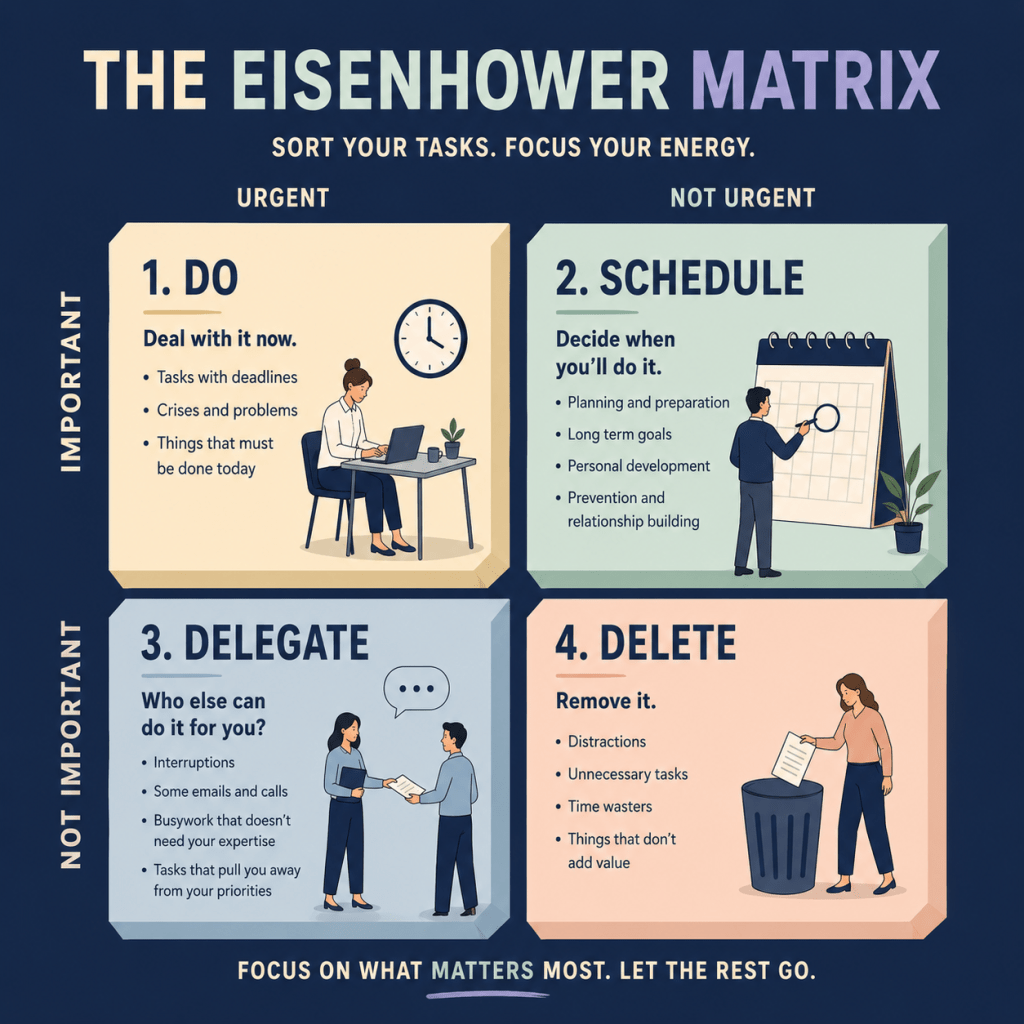
Sometimes, when we do not categorise or organise our lists, we end up with ‘Send brief e-mail to parent x’ next to ‘review Y9 assessment system’ – two very different tasks. In reality, the specific categories do not matter that much; the act of sorting everything allows you to filter everything and consider its role in your list. You may choose to use something priority-based, or you may just sort things into a timeframe – do today / tomorrow/ this week/ this term. It’s worth also remembering that some jobs take little brain power, and some require concentrated thinking, or conversations with others – this helps you to categorise them.
Writing everything down that you need to do can seem overwhelming, but it helps to capture it all – often I do this and then realise there is less to do than I thought, or at least, it appears more manageable in sorted boxes than it did before, all floating around in my mind or on post-it notes. It can make the day seem like – oh wait, I only have 3 things to do by the end of today – rather than – oh dear, I have 75,000 things to do.
9. Do something you’re avoiding
I think often tasks linger on lists – you know the ones. They need to be done, they are necessary, but not too time-dependent, but they just feel like they are going to take a really long time, or be repetitive, or be a faff, and so we just avoid them. I am thinking of a particular one in my current job role that I always avoid because it takes time, has to be done every week, and isn’t directly impactful to my team (although I recognise its bigger impact) and so I avoid it. Sometimes I just end up forcing myself to sit down and work through it for a term, so that it’s done.
And so that’s the next piece of advice – find that stone in the shoe of your to-do list, and deal with it. Objectively the stone might be small, but it keeps rolling around in there, and you need to take the shoe off and shake the stone out to avoid that little nudge each time you step at a certain angle. And so, these tasks do become psychologically bigger than they are in reality, because they rumble as an undercurrent, moving across various to-do lists and being delayed for as long as they can.
Sometimes, removing them quickly, even if it’s a small task, can create immense relief. It is the avoidance that tends to make the tasks feel bigger than they are, rather than the actual practical act of doing it. Another thing to do is consider why you are delaying it and start there. If it’s something you are unsure of, perhaps you need to have a conversation with someone for advice first. If you are unsure of how to do it, seek out the person who has given you the task and ask for clarification – this shows diligence and a willingness to do things right, not a weakness at all. Consider – what task am I secretly hoping will disappear? Locate it, and action it. I promise you will feel better after.
10. Don’t look at the whole mountain
We started this blog by going back to the core purpose – the things you want to achieve as a middle leader, and this in some ways may seem like the big overview of all your tasks. But in reality here we are looking at core purpose, and the thing I try and avoid is being overwhelmed by the sheer volume of what middle leaders have to do. The truth is that being a strong head of department or year has no clear, definitive finish line. There will always be another cohort, another exam season, another set of data to analyse, another member of staff who needs support, another unit that needs tweaking.
If you try and carry all of that, it will feel enormous. It’s okay to mentally know that there are long term strategies, things you want to achieve by the end of the year, to stay five steps ahead, but sometimes it’s also okay to just look at the next step, the next week, or day, or just focus yourself within the current day. The truth is, and the core mantra of the book, is that deliberate changes and improvements do not happen overnight. They happen in the repeated, consistent actions we repeat time and time again. Those smaller decisions and actions we take can often not even make it on to the to-do list, but they also add up, arguably these micro moments are more valuable than the tasks we sit down and get done.
Direction and distance as a middle leader do not mean the same thing. You do not always have to be covering ground, instead, you can be steering your ship with your daily habits. Sometimes it is useful, in times where things seem overwhelming, to pause and look back. I do this as soon as it starts to get too much. I ask myself, where was this team 6 months ago? A year ago? 3 years ago? This helps to ground me in the reality that I am changing things, making them better for the students, and that whilst I may have a lot on my plate at the current time, I know the difference and impact I am making. This can also frame the mountain as not something huge that is ahead of you but instead a journey you are on, and you may start to feel that what you have already achieved is much bigger than the tasks and journey that lie ahead.
Perspective is a wonderful thing – so allow yourself to see things as they are, see what you have achieved, and to carefully plan the next steps of your journey. It will all get done, eventually, and it will all be okay.


Leave a Reply