- Power resources
- Relationship resources
- ** UPDATE – RESOURCES AND HOMEWORKS**
- Change resources
- Memory resources
- Homework revision resources
I did a post a while back about how I teach 1.1 in Macbeth and it was well-recieved, so I thought, right, I’ll do some more of these blogs. And yup, best laid plans and all… but I saw the following tweet today about GCSE English Literature, and it got me thinking:
Now, I’ve mentioned in the past that I’ve had lots of experience marking literature. I’ve also been very openly proud of the results in literature in my own classroom and the departments I have helped to guide. And, having mapped out my final four weeks of revision in the same manner I always do (yes, it’s a spreadsheet), I thought, perhaps I should share this approach as a) a blog that I promised to keep up with and b) an antidote to this (valid) tweet. And I’ll chuck some resources in too, because, that’s always a bonus for everyone.
This image will probably help to explain what I’m waffling on about:

So, as you might be able to tell (from the title and image above) for the final four weeks of teaching, I have several objectives to hit:
- Get students to think about texts conceptually. Ensure all students have moved through that key threshold concept: the text is a construct. This is the only way for them to move beyond a grade 4-5.
- Start to strenthen the schema of knowledge they have built up. Yes, by this point, they should know a range of quotations, but they should also know who says them, when they are said, and what their ideas are about these quotations.
- Cover all the exams, as frequently as possible, so that things start to come together for students. I find this is the time where I no longer get asked “what paper is this in” … “Do I have to answer a question on those poems?” – it just all starts to come together.
- Repeated independent practice. I said this in response to a tweet on Twitter and got slated for it. I wish people could see me teach, see how my students write about and engage with their texts, before they jump down my throat about repeated independent practice. Sorry, defensive tangent. What I really mean here is that I want students to be coming up with their own idea, interpretations, responses, over and over again, to different facets of the text. This isn’t about drilling. It’s about building confidence and stamina and ideas. And it’s also about giving me lots of chances to read their work and fine tune it.
So each year I pick a series of themes that tie the texts together. I will think carefully about this – there are lots of avenues in when you think about it, and I’m really trying to consider what my students need to grasp conceptually. Power is an easy win, and often where I start (conflict obviously works, as do guilt, time, division – think generic concepts. This year I’m doing power, relationships, change and memory. I also try to think about what might come up in the exams based on past papers, and ensure it’s covered). So the lessons across a week then take the basic approach of
Step 1: Agreeing on a class definition of power following some discussion. I’ll try to elicit the things we need to know about power (or whatever theme) at this point. So we will discuss synonyms, agree a definition, and push certain things – “What gives people power? What happens when people abuse power? Does money always equal power? Is power something we have automatically or something we earn? What is the most powerful thing in the universe?” I’ll use images to prompt what I need them to come up with initially with the think-pair part, like so:

Step 2: After some fruitful discussion (and likely, note-taking) where we can pull apart the concept as a class, we get to the texts. Here is where the repeated practice happens – mini questions (just on the board on a PPT) and 5 minute – 1o minute bursts of planning and writing. All the questions link to – you guessed it – power. Like so:

Depending on the vibe in the room we might discuss a little about the extract, power across the narrative etc, but sometimes I might just get them to do it cold. Depends where the class are at really.
This step is then repeated X4 – for my four core texts, in the order they will sit them in the exam, so I’m essentially running through the structure of papers too. (I’ll chuck the PPT at the end of this so you can see all this together).

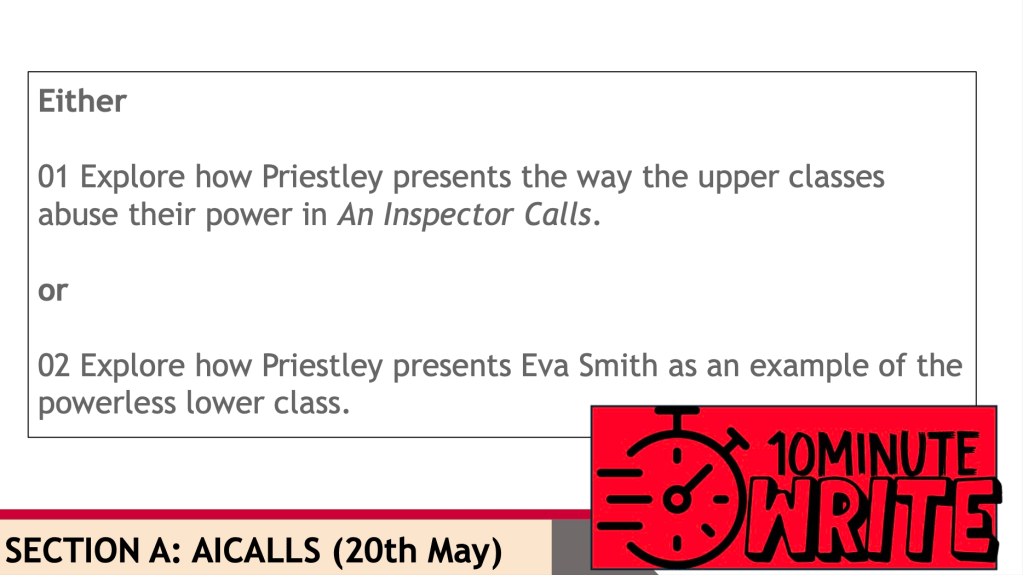
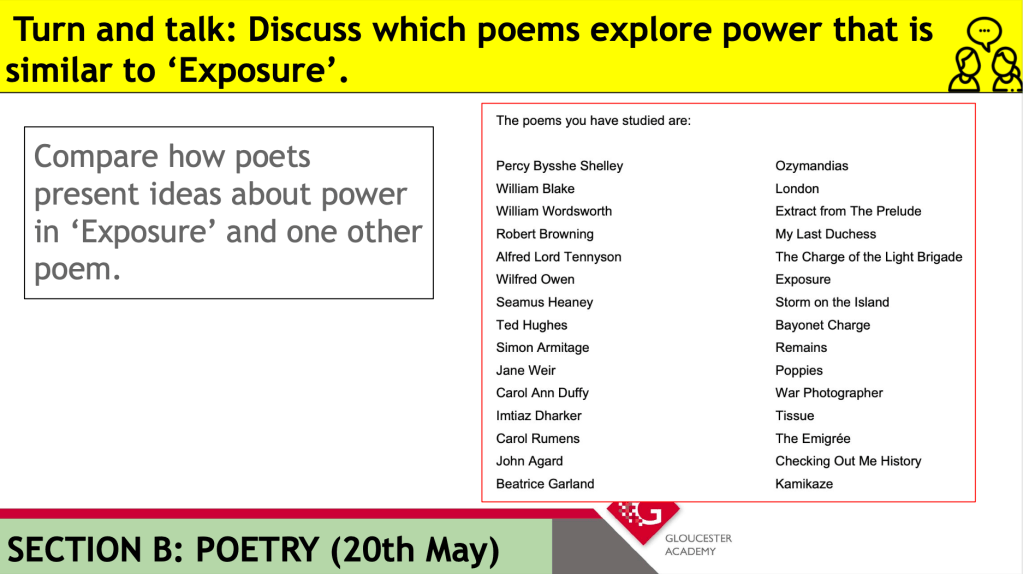


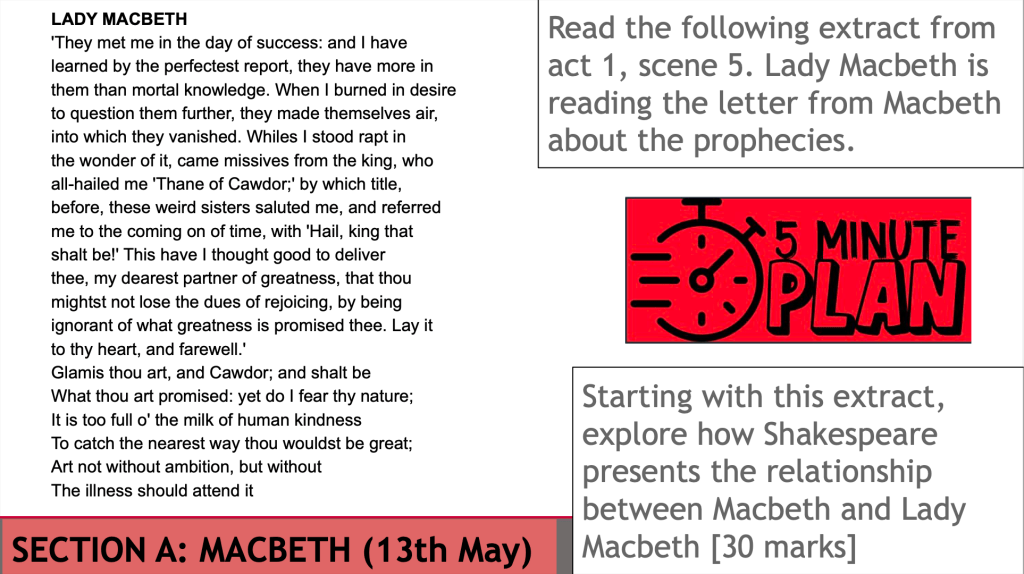

Step 3: the next step is to tie all this together in the taught texts – a think-pair-share discussion regarding what the texts teach us. This is again pushing at that understanding of the text as a construct. I don’t want to debate whether they can get into Shakespeare’s head. What I’m really looking for here is trying to push that recognition of a text being a product of its context, but also to have their own ideas about the concept. We are constantly looking to move this understanding forward, and building their ideas about texts.

Now – here is where we have to get clever.
Step 4: We begin to build on the concept with carefully selected unseen texts. This will begin with an unseen poem (already shared in the unseen poetry booklet available on the resources page) followed by two lessons on language papers, targeting a particular question (always writing too) linked to the concept. So, for power, I’ve picked an extract from Animal Farm. This is intentionally to build on the ideas of abuse of power, fear, being a tyrant etc. And then for paper 2 we look at two extracts for power of nature to link to the poems. Again, constantly building up vocabulary and conceptual understanding. This also has the added bonus that you don’t really have to give too much prior knowledge as they should have some from the literature texts, so the sources don’t feel completely random. See examples below (resources shared at the end for power/relationships) – remember these are short versions of the papers, focused on key skills needed.
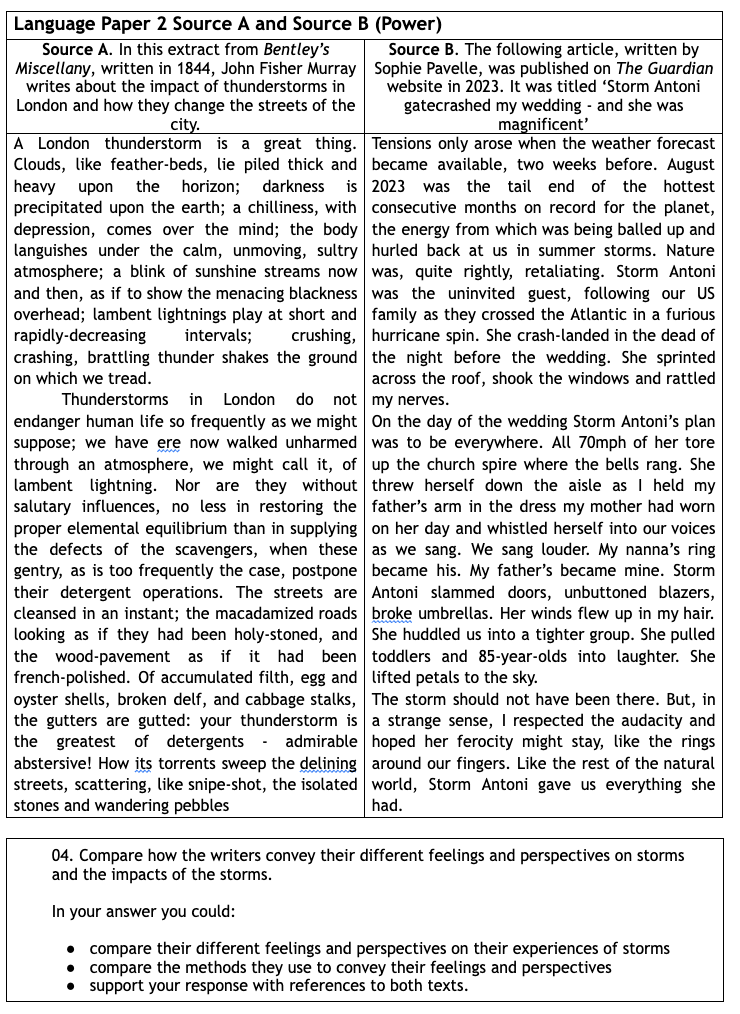
Step 5: so after working closely with a text and focusing in on one-two question(s), we then move to a writing question, that again, links conceptually. Here it’s time to bring back all the vocabulary we’ve been returning to, to have their own ideas about the concept in the wider world, and to share those ideas in the form of writing. So what they have gained from their study of literature starts to build a foundation in their writing, and they can draw on all those ideas for their own perspective – whether that be creative or viewpoint based.

That’s pretty much it, summarised pretty rapidly on a car journey back from Wembley (seriously, I get really bored in the car).
Let me know if you have any questions. I’ve chucked the PPT below if useful, but please remove any school based stuff before you use any of it! So basically, please adapt…! And I’ve added the power and relationships ones so you can see how it all works across two weeks.
Power resources
Relationship resources
I hope there is something useful here for somebody in this final sprint. Good luck to you and your year 11.
** UPDATE – RESOURCES AND HOMEWORKS**
Change resources
Memory resources
Homework revision resources
The idea here is that students are given 4 mini mock exams for literature and 2 question 5 mocks to plan for homework. They fit on to A4 – literature 2-sided and language on one side. These may be useful for homework, intervention, tutor time, or just for additional resources for students.


 Laura Webb CPD
Leave a reply to Sally-Ann Enright Cancel reply